Financial Scams
How to Avoid Common Investment Scams?
Feb 09, 2026
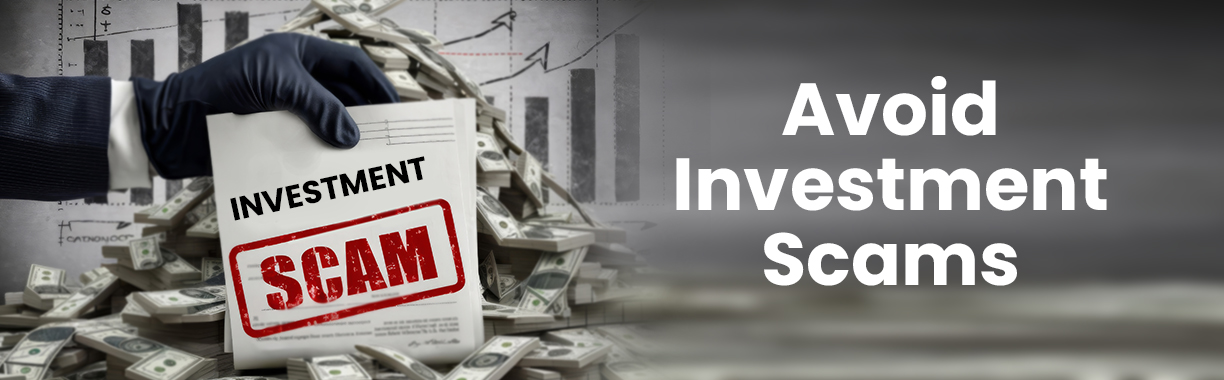
If an investment opportunity sounds too good to be true, it usually is. Yet every year, thousands of people fall for investment scams, not because the people are careless, but because scams are made to look convincing. They often use tack-tick like urgency, confidence, and promises of quick gains to push a person into making decisions they wouldn't make otherwise.
The good news is that you don't need expert-level financial knowledge to protect yourself. Understanding how these scams work can help you know what to watch out for and can go a long way in letting you avoid any investment scams.
This article goes into some warning signs, popular scam types, and simple checks that can help you avoid falling prey to investment scams, especially in today's digital environment.
Why Investment Scams Are So Effective?
Scammers rarely rely on complex tricks. Instead, they appeal to emotions such as fear of missing out, greed, or the desire for quick financial improvement. Many investment scams will follow familiar patterns:
- Promises of unusually high interest rates /returns or “risk-free” returns.
- They pressure you to act quickly.
- They make claims of insider access or exclusive opportunities.
- They do not have clear documentation or provide limited documentation.
These tactics are effective because they bypass logic and push individuals to act before verifying any details.
Common Types of Investment Scams to Watch Out For
Learning about common forms of investment scams makes them easier to spot. Some frequently reported examples include:
- Ponzi schemes: Returns to existing investors are paid using money from new investors rather than genuine profits.
- Pump-and-dump schemes: Prices of little-known stocks are artificially inflated through false information and then sold off quickly.
- Fake advisory services: There are unregistered individuals who offer “sure-shot” trading or investment advice.
- Pre-IPO and unlisted share scams: They offer shares at attractive prices with misleading claims about imminent listings.
While the formats may vary, the underlying goal of these investment scams remains the same, extract money before the deception is discovered.
Key Warning Signs Before You Invest
Red Flags That Should Not Be Ignored
If an opportunity displays several of the following traits, caution is warranted:
- Guaranteed or “assured” returns
- Lack of clarity on how profits are generated
- Unverifiable credentials of the individual or firm
- Requests for payments through informal channels
- Reluctance to provide written information
Many cases of investment scams succeed because investors overlook one or more of these early warning signs.
Practical Steps to Protect Yourself
What You Can Do Before Committing Money
If you take a few basic precautions, it can significantly reduce the risk of investment scams:
- Verify registration: Check whether the intermediary or platform is registered with the Securities and Exchange Board of India (SEBI).
- Research independently: A simple online search often reveals complaints, warnings, or regulatory alerts.
- Understand the product: If you cannot clearly explain how the investment works, it may not be suitable.
- Avoid pressure: Legitimate investments allow time for consideration and questions.
These steps help protect investors from both overt scams and subtler forms of investment fraud.
Genuine Investments vs Scam Offers
| Aspect | Genuine Investment | Scam Offer |
|---|---|---|
| Returns | Market-linked, variable | Fixed or guaranteed |
| Transparency | Clear product details | Vague or secretive |
| Regulation | Registered and regulated | Unregistered or unclear |
| Urgency | No pressure tactics | “Limited time” offers |
| Documentation | Written disclosures | Verbal promises only |
Such comparisons make it easier to differentiate between legitimate opportunities and investment scams at an early stage.
Role of Awareness and Regulation
Regulators regularly issue public advisories highlighting emerging scam trends. SEBI, for instance, publishes investor alerts and educational resources aimed at preventing investment fraud. While regulation plays a vital role, individual awareness remains the first line of defence against investment scams.
Why “Get Rich Quick” Promises Are Risky
Financial markets do not offer shortcuts without risk. Schemes promising fast, effortless wealth often rely on misleading narratives rather than sound fundamentals. History shows that most investment scams collapse once new inflows slow down, leaving late participants exposed to losses.
A disciplined approach, realistic expectations, and basic verification go a long way in avoiding such traps.
Staying Alert Is an Ongoing Process
Avoiding investment scams does not require you to have deep financial expertise. It requires patience, scepticism, and a willingness to verify any claims made independently. As an investor, you should take time to understand the claims, confirm the regulatory status, and avoid making emotional decision-making are better positioned to protect your capital. For those who are seeking to build long-term financial knowledge and make educated market-related decisions, understanding how scams operate is a part of being a responsible investor.
To learn more about safe investing practices and market awareness, you can explore the educational resources available through Indiabulls Securities Limited (formerly Dhani Stocks Limited).
FAQs
1. Are investment scams always illegal?
Not always immediately, some schemes operate in grey areas before being identified as misleading or fraudulent by regulators.
2. Can educated investors also fall for scams?
Yes. Many scams are designed to appear sophisticated and can affect both new and experienced investors.
3. Is online investing more risky than offline investing?
The risk depends on verification of the source, not the medium. Online platforms can be as safe as offline if you make sure they are regulated and transparent.
4. What should I do if I suspect a scam?
You should avoid investing further and report the matter to the relevant regulatory authorities or investor grievance platforms. If it is an email or electronic transfer, you should visit the cybercrime division.
Disclaimer: The contents herein are only for information and do not amount to an offer, invitation or solicitation to buy or sell securities or any other financial product offered by Indiabulls Securities Limited (formerly Dhani Stocks Limited / DSL). The content mentioned herein is subject to updation, completion, amendment without notice and is not intended for distribution to, or use by, any person in any jurisdiction where such distribution or use would be contrary to law or would subject Indiabulls Securities Ltd. (formerly Dhani Stocks Ltd. / DSL) to any licensing or registration requirements. No content mentioned herein is intended to constitute any investment advice or opinion. ISL disclaims any liability with respect to accuracy of information or any error or omission or any loss or damage incurred by anyone in reliance on the contents herein. This blog is based on information obtained from public sources and sources believed to be reliable, but no independent verification has been made about its accuracy or its completeness is guaranteed. This content mentioned in this blog is solely for informational purpose and shall not be used and/or considered as an offer or invitation or solicitation to buy or sell securities or other financial instruments. ISL will not treat recipients as customers by virtue of their receiving this report. The securities / Mutual Fund units (if any) discussed and opinions expressed in this blog/report may not be suitable for all investors. Such investors must make their own investment decisions, based on their investment objectives, financial positions and specific needs. ISL accepts no liabilities whatsoever for any loss or damage of any kind arising out of the use of this report. Past performance is not necessarily a guide to future performance. Investors are advised to see Risk Disclosure Document to understand the risks associated before investing in the securities markets. ISL may have issued other blogs that are inconsistent with and reach different conclusion from the information presented in this blog.
Indiabulls Securities Limited (formerly Dhani Stocks Limited) is a Mutual Fund Distributor registered with ‘Association of Mutual Fund of India’ (AMFI) vide ARN number ARN-160411. Corporate Identification Number: U74999DL2003PLC122874; Registered office address: A-2, First Floor, Kirti Nagar, New Delhi - 110008. Tel.: 011-41052775, Fax: 011-42137986.; Correspondence office address: Plot no. 108, 5th Floor, IT Park, Udyog Vihar, Phase - I, Gurugram - 122016, Haryana. Tel: 022-61446300. Email: helpdesk@indiabulls.com